
This blog is part of a series featuring the 2026 YPG Mentorship Programme participants and their valuable learnings in the field of solid waste management and the circular economy.
Mentee: Moises Vargas Castro
Mentor: Obaloluwa Dairo
Circular economy projects in emerging markets do not fail due to a lack of ambition. They fail because no one will fund them.
Private companies, public entities, and circular economy consultancies across Latin America face a common challenge: the value they generate through material recovery facilities, organic waste treatment through anaerobic digestion, and products redesigned to last longer is real and measurable but not easily recognized to the banks and investors that could help them scale. Projects with environmental and economic merit often stall at the financing stage. This is not because the fundamentals are weak, but because they have not been translated into a language that credit committees understand.
What does a bank actually need to say yes?
The answer is simple. Banks need evidence of stable revenue, reduced exposure to commodity price volatility, and a verifiable link to a recognised sustainability standard. These are not abstract environmental goals, but proxies for lower risk and more predictable returns. And that is precisely where circular economy projects have an untapped advantage, one they are currently failing to communicate.
Consider the difference between two plastic waste management operations. The first collects mixed plastic waste and sends it with other types of waste to a sanitary landfill, generating revenue only from tipping fees. The second operates a mechanical recycling facility that sorts, washes, and pelletizes post-consumer plastic, selling recycled resin directly to manufacturers as a substitute for virgin material. The second reduces dependence on petrochemical input, generates stable offtake revenue through supply agreements with industrial buyers, and produces a measurable reduction in primary resource extraction. It is a fundamentally different credit risk. But without a structured way to measure and communicate that difference, both could look identical on a loan application, and the more innovative project often loses.
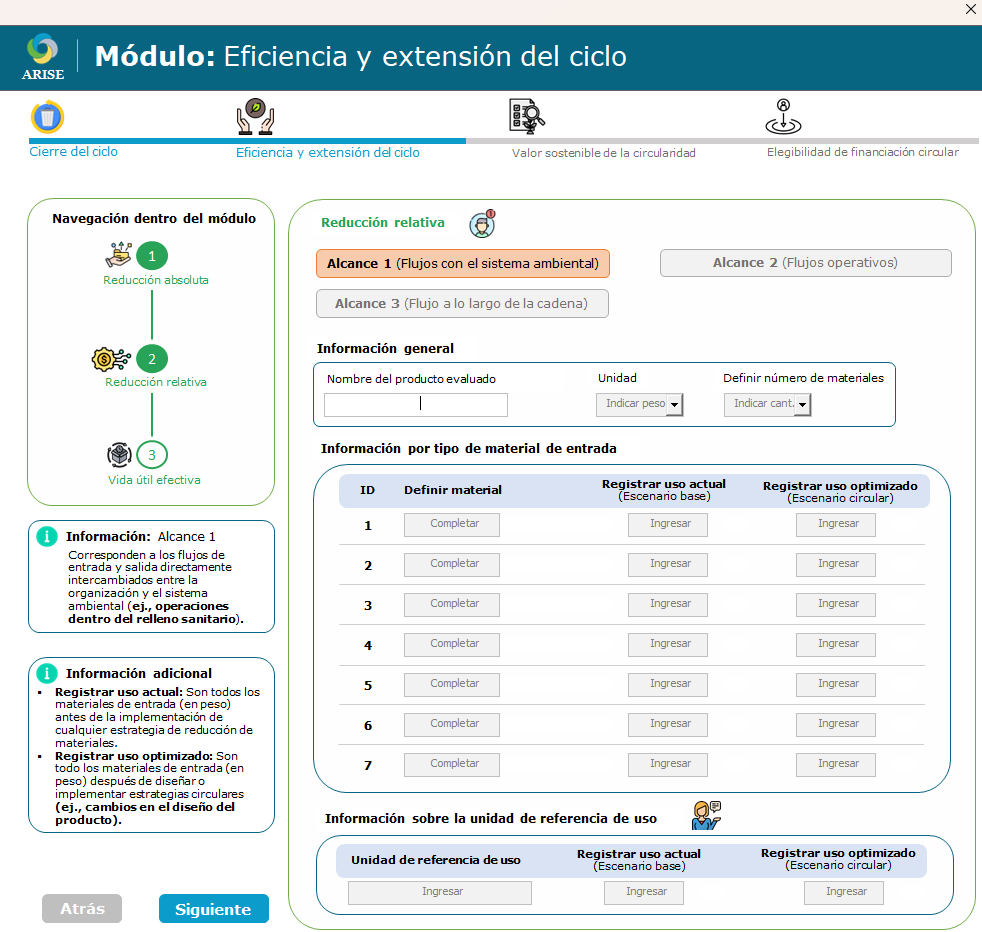
Circular economy tool designed by Ambire Global
This is the core opportunity: circularity measurement tools are not just reporting instruments. When companies can quantify material flow rates, recovery percentages, and avoided emissions and connect these indicators to financial materiality, they generate the data that unlocks green credit lines and sustainability-linked loans.
The barriers no one acknowledges
Most Latin American countries lack a standardized definition of what qualifies as “circular” for lending purposes, leaving financial analysts without a reference framework. In cities such as Bogotá, the informal waste sector manages part of recyclable materials but generates no formal data trail compatible with credit assessment. Furthermore, most small circular economy businesses lack the financial history that commercial banks require for conventional loan approval.
Solving this issue requires two parallel shifts. Financial institutions need sector-specific circularity scorecards, practical tools that allow analysts to assess a project’s circular performance without demanding a full sustainability audit that most SMEs are unable to produce. On the other side, circular economy companies also need structured support to translate operational metrics into the financial disclosures that lenders and investors recognize.
The institutions that build this capability first will access a largely untapped market: projects with solid fundamentals and growing regulatory tailwinds, currently invisible only because the bridge between their performance and available capital has not been built.
This perspective was shaped in part by the mentorship I received from Obaloluwa Dairo through the ISWA Young Professionals Group mentoring programme in 2025. That experience pushed me beyond technical circularity frameworks and toward a harder question: what would it actually take for a financial institution to fund a circular economy project? I am grateful to ISWA and to my mentor for creating the space to think differently, and for helping me connect the work we do at Ambire Global to the broader challenge of making circular economy investment real.