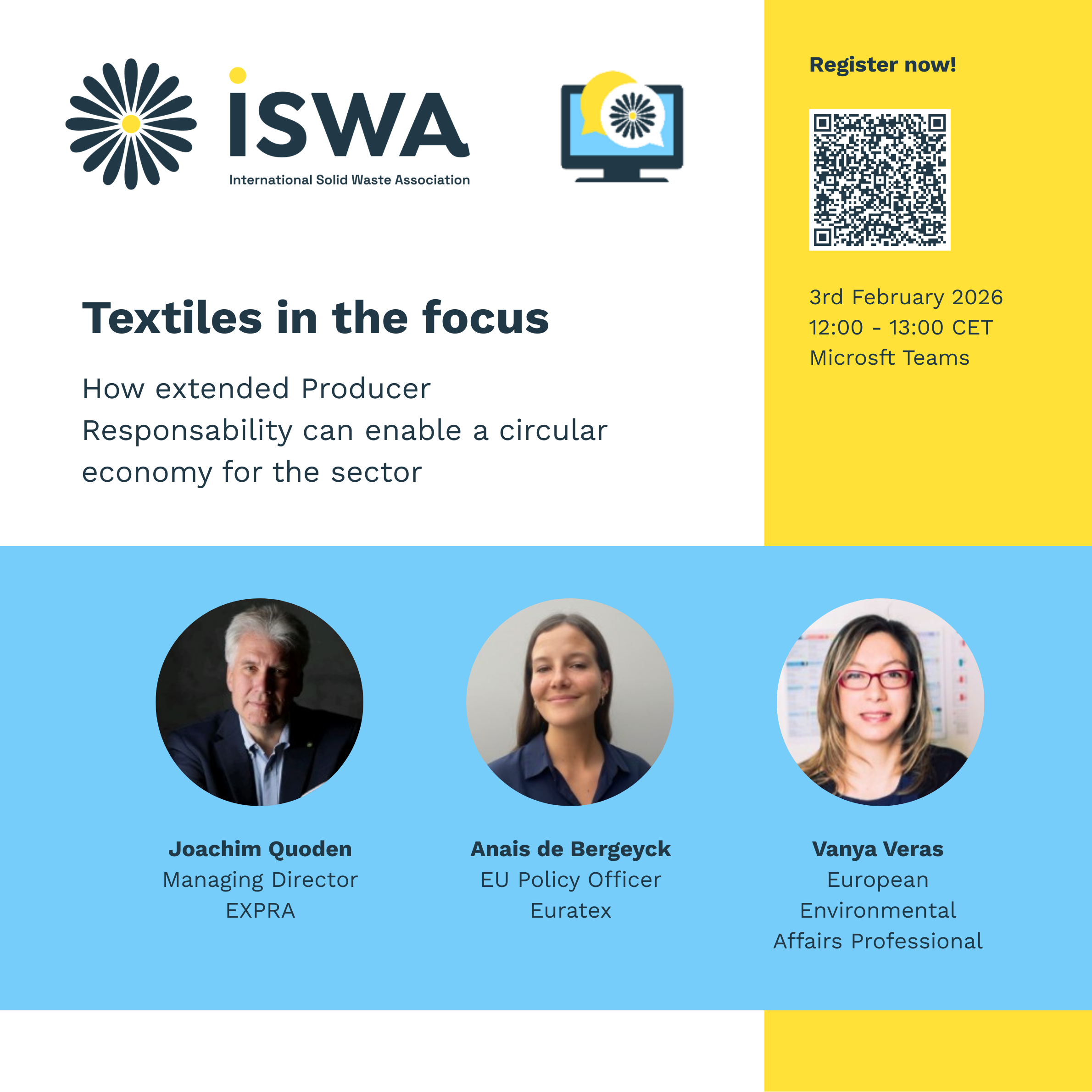
Opening the session, Joachim Quoden (EXPRA) outlined why textiles have become a pressing topic for waste management stakeholders. He noted that separate collection of textile waste is now mandatory across the EU, while financing mechanisms and system readiness remain uneven. In his view, this has created uncertainty for municipalities and operators, while leaving room for stakeholders to still influence how national EPR systems will be designed.
Drawing on her work with Producer Responsibility Organisations (PROs), Anaïs de Bergeyck from Eurotex highlighted the imbalance between collection obligations and system capacity. She observed a pattern: that although textile collection volumes are increasing, the quality of collected textiles is declining, placing pressure on reuse organisations, charities and municipalities. According to her, rather than focusing on collection alone, textile EPR should be designed to finance the full value chain, including collection, sorting, preparation for reuse, recycling and market development. She also emphasised that quality incentives, harmonisation across Member States and effective enforcement are essential elements for a functioning system.
As an independent European Environmental Affairs professional, Vanya Veras offered a strategic reflection on EPR as a policy tool. She stressed that EPR should not be seen as a “magic solution”, but rather as an instrument that can be either used well or poorly, depending on its implementation. Textile EPR, in her opinion, is an opportunity to rethink textile waste as a resource and to encourage investment in European sorting and recycling infrastructure. She argued that long-term success would require cooperation across the entire value chain, as well as greater transparency around volumes, treatment capacity and investment needs.
During the discussion, no single “ideal” system was identified but the speakers agreed that fragmented approaches could increase costs and instability. On low-quality textiles and exports outside Europe, the speakers expressed concern that exporting used textiles might shift environmental and social challenges elsewhere rather than resolving them.
The discussion concluded with a key message that textile EPR, if done right, can relieve pressure on municipalities, stabilise existing collection systems and create the conditions for a truly circular textile economy. Done poorly, it risks increasing costs, volumes and public frustration without improving outcomes. Overall, the webinar highlighted the complexity of textile EPR and the importance of system design but acknowledged that many questions remain on its implementation across Europe.
Watch our webinar recap by clicking here.