
This blog is part of a series featuring the 2026 YPG Mentorship Programme participants and their valuable learnings in the field of solid waste management and the circular economy.
Mentee: Diksha Rana
Mentor: Corinne Trommsdorff

Why Emissions Terminology Matters in Waste Management
Reduced or avoided emissions? Does it matter whether we use one word or the other? A colleague recently shared obtaining a “net negative” result from his GHG emissions estimation tool and said, “we have reduced these emissions through our intervention”. However, to get there, he had to have both reduced and avoided emissions, if we use these words as defined by the climate community.
If “reduced” and “avoided” emissions are often used interchangeably by the general public. The difference is not just a matter of semantics; they have very different meanings in the context of climate action. So using the right terminology matters to avoid overstated claims, inconsistent reporting and non-aligned priorities of emissions reduction projects. Clearly distinguishing between the two ensures robust, credible, transparent and comparable assessments.
Understanding Reduced Emissions
If one is doing the same activity with lower emissions than before, this is reduced emissions. In other words, reduced emissions are the GHG emissions that were lowered within the existing system, as a result of additional actions.
This could be as simple as optimising waste collection routes. The same activity of collection is being performed from the same number of households, but emissions are reduced because travel routes are optimised for efficiency. Similarly, using an electric vehicle instead of a gas guzzler could reduce emissions directly.
Reduced emissions are generally more directly observable. In this example, we can directly measure the amount of fuel used for the vehicles before and after optimisation, and see that fuel use and thus emissions are reduced.
Simply put, reduced emissions are emissions occurring within the area of responsibility of the service or organisation reporting them, as a result of direct actions within their control to perform their activity more efficiently.
Understanding Avoided Emissions
Avoided emissions are emissions that are reduced outside the scope of an organisation’s activities. They result from offering a product or service to a third party in place of a more GHG-intensive solution they were previously using. They could result from using any product or service that helps any individual or organisation emit less compared to what they would normally do.
Avoided emissions are therefore dependent on the assumptions made regarding what was “normally done”. These emissions may have “alternate realities” in different scenarios. These scenarios compare what happened with the use of the waste management facility’s product or service (solution implemented) versus what would have happened otherwise (reference scenario).
For example, we might assume that virgin material is not produced if we provide recycled materials. In this case, the recycling activity enables us to prevent emissions related to virgin material production that would have occurred in the business-as-usual scenario or reference scenario: this can be claimed as “avoided emissions”.
If in your system boundary, you have control over decision-making for using a product or service that generates lower emissions than the one you were using in the existing conditions (baseline), then it would be termed as scope 3 emissions. If you sell a service or product, the GHG emissions associated with its use and final disposal are also assessed under scope 3. However, when you sell or provide something that a third party uses in place of another more GHG-intensive service, then you can claim avoided emissions, also sometimes called “scope 4 emissions”, in comparison to a reference scenario.
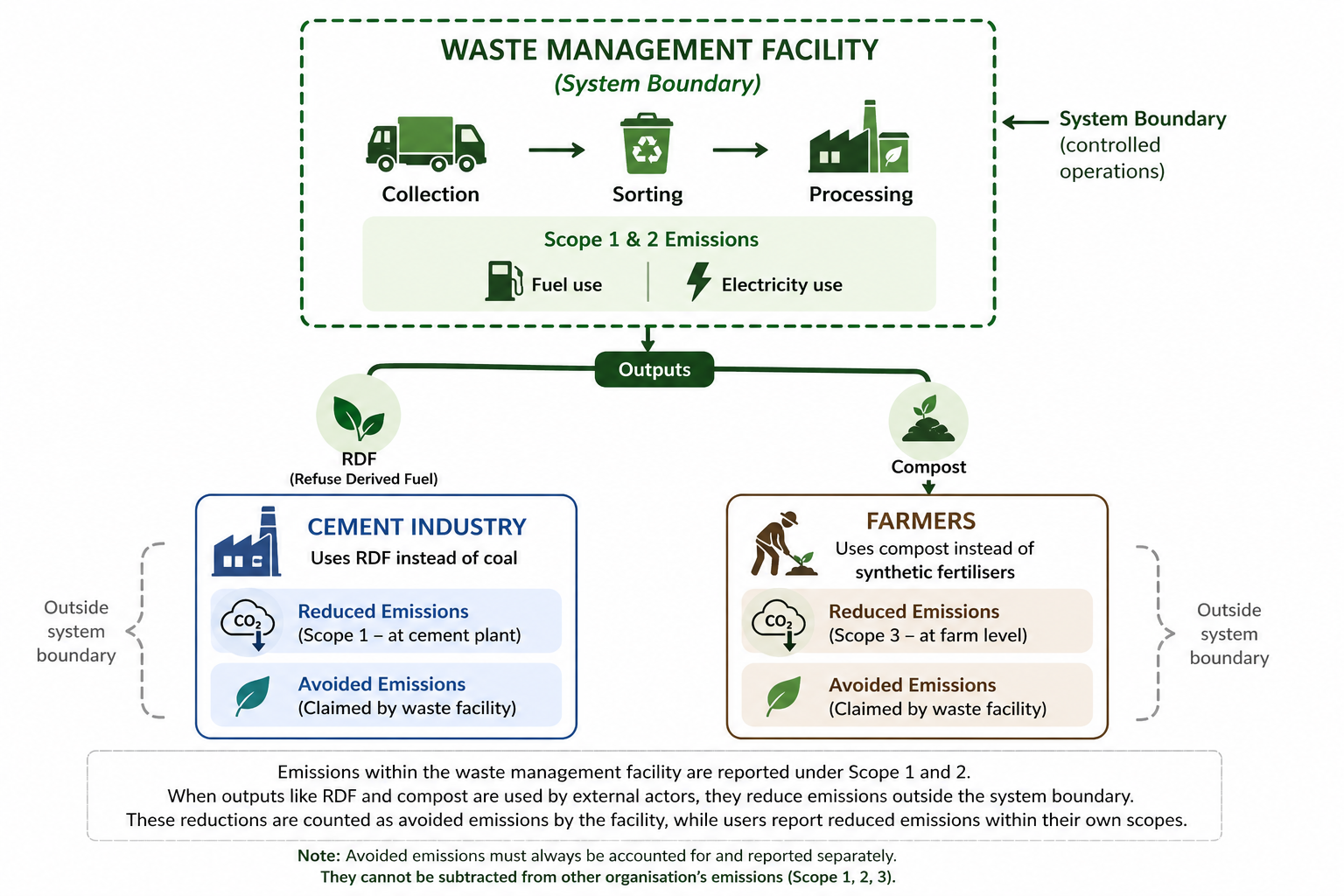
Avoided emissions must always be accounted for and reported separately. They cannot be subtracted from other organisations’ emissions (Scope 1,2,3).
Case Study: Understanding these emissions (reduced vs avoided) within the waste value chain at Waste Warriors Society, India
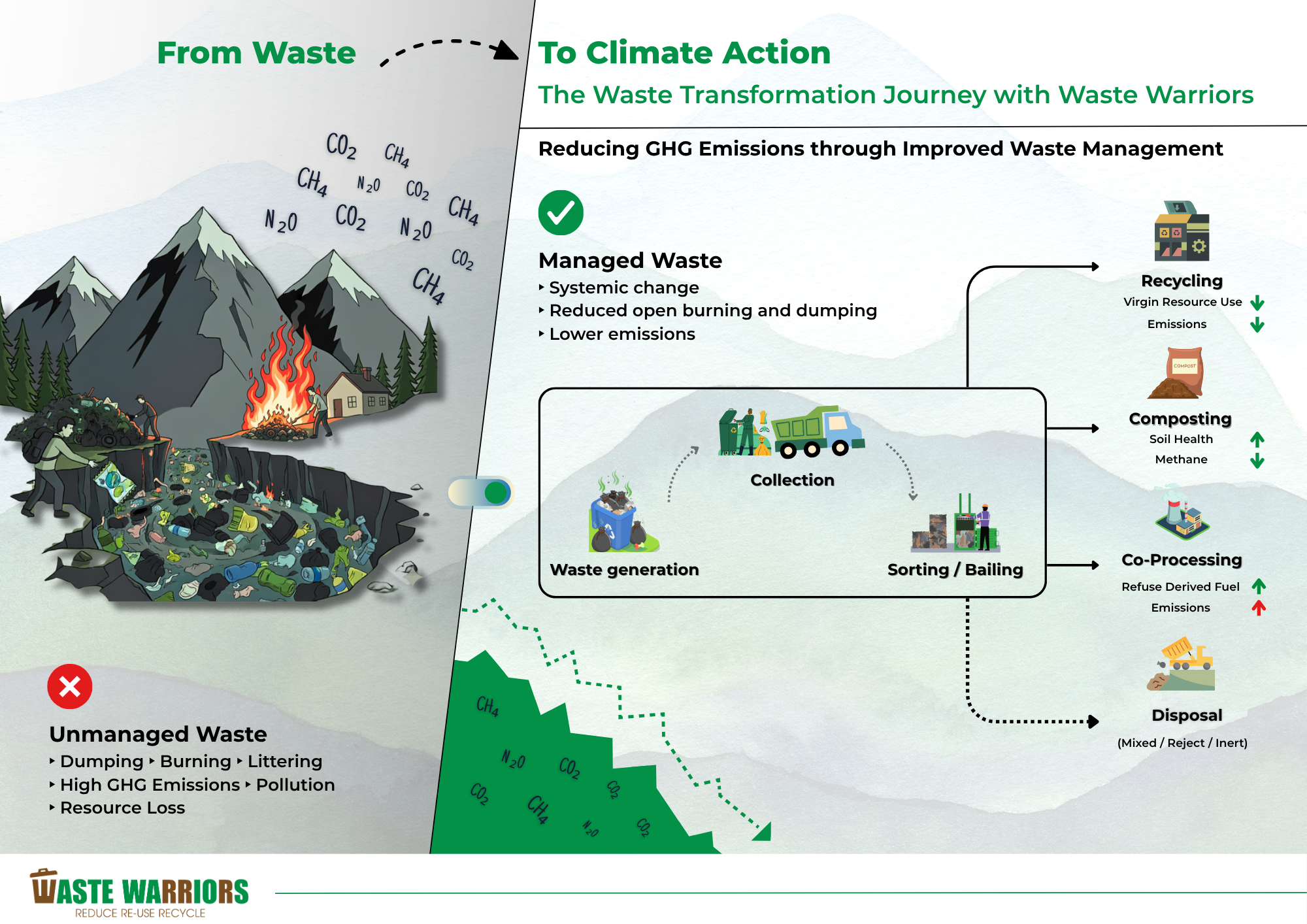
The figure shows two different realities: on the left, the baseline (what is usually happening), and on the right, an alternative scenario where emissions are reduced.
For example, refuse-derived fuel (RDF) can be produced from low-value materials (e.g., multi-layered plastics, damaged textiles or cardboard) sorted in the Material recovery facilities. When sent for co-processing in cement factories, it is used in place of fossil fuels such as coal. RDF emits less fossil CO2 than coal, because only part of it is made of fossil-based plastics and the rest is made of organic carbon. The difference in fossil CO2 emissions between the coal (reference scenario) and RDF (new solution) can then be claimed as “avoided emissions” by the waste management facility. On the other hand, the cement factory claims reduced scope 1 emissions within their facility because they made the decision to use a less carbon-intensive fuel.
The second example could be organic waste converted into compost. After exiting the facility, it is distributed among community members to use in their fields as a solution to reduce the use of synthetic fertilisers. Here again, the difference between emissions generated by the production of synthetic fertilisers versus those of compost can be claimed as avoided emissions by the waste management facility. On the other hand, the farmers claim reduced emissions under their scope 3 because they made the decision to use a fertiliser that generated lower GHG emissions prior to entering their farm.
Highlighting the “avoided emissions” originating from waste management facilities is critical to drive climate investments towards the valorisation of waste – in this case, the production of RDF and of organic fertiliser. Indeed, if only scopes 1, 2, and 3 are considered, investing in waste valorisation might increase GHG emissions of the waste management facility because additional processing is needed. However, when considering the “avoided” emissions, it becomes clear that the waste management facility’s activities are actually contributing to reducing global GHG emissions and are therefore a good climate investment.
The distinction is important in the climate space. Appropriate use of these terms can prevent double counting of emissions and enable reliable carbon accounting. Accurate claims of emissions can enhance effective policy and decision-making based on waste management interventions.